
Few UFO cases have influenced modern alien mythology as deeply as the story of Betty and Barney Hill. Their alleged encounter in New Hampshire in September 1961 did not merely become another entry in the long catalogue of strange lights and unexplained aerial phenomena. It became something larger: a narrative structure, a cultural pattern, and eventually a template for the modern alien abduction story.
The Hills’ account contains many elements that would later become familiar in UFO literature, documentaries, films, and alleged abduction reports: a lonely night road, a strange light in the sky, a craft, humanoid beings, missing time, hypnosis, medical examination, emotional trauma, a star map, and physical traces. The University of New Hampshire, which holds the Betty and Barney Hill Papers, describes the collection as containing correspondence, journals, manuscripts, newspaper clippings, photographs, slides, DVDs, and artifacts connected with their UFO experience and later research. The collection also includes Betty’s dress, star-map correspondence, and related materials.
Whether one approaches the case as evidence of extraterrestrial contact, as a psychological mystery, as folklore, or as a case study in memory and culture, the Hill incident remains one of the most important events in the history of alien-abduction narratives.
The people behind the case
Betty and Barney Hill lived in Portsmouth, New Hampshire. Betty was a social worker and Barney was a postal worker. They were also active in civic life and civil-rights work. According to the University of New Hampshire archive, both were members of the NAACP, and Barney served on a local board of the U.S. Civil Rights Commission. This background matters because the Hills were not anonymous figures invented by pulp magazines. They were real people with reputations, community ties, and social responsibilities.
Their case also took place in a specific historical atmosphere. The early 1960s were marked by Cold War tension, rapid technological change, nuclear anxiety, the space race, and growing public fascination with flying saucers. UFO reports had been circulating since the late 1940s, but the Hill case helped shift the focus from sightings of distant objects to intimate, personal encounters with non-human beings.
The alleged encounter in New Hampshire
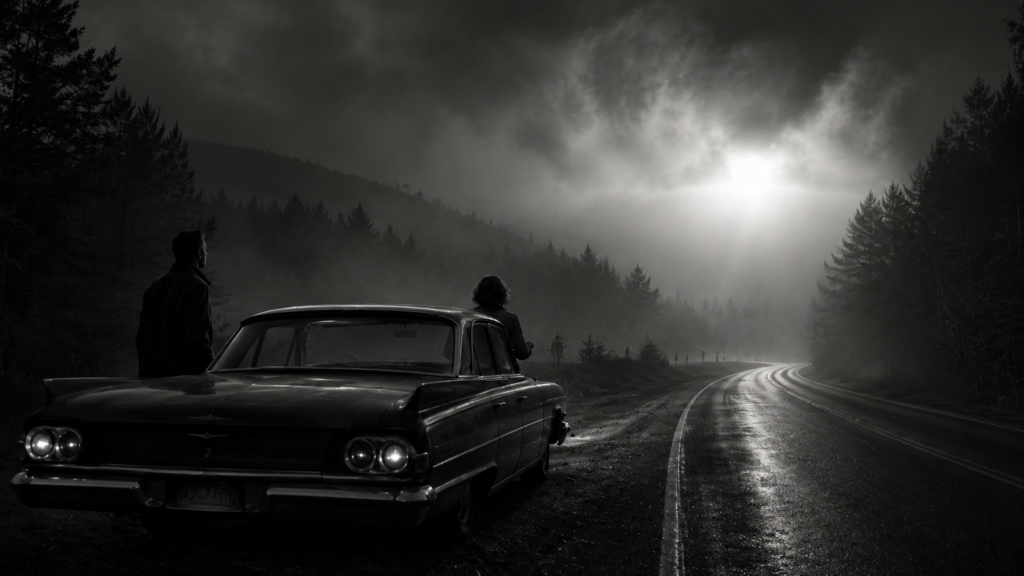
The basic story begins during the Hills’ return journey from a trip to Montreal, Canada. They were driving home through the White Mountains of New Hampshire at night when they reported seeing unusual lights in the sky. The UNH archive summarizes the account as a sighting of lights approaching from the sky while the couple drove through the night. According to the later narrative, the incident escalated from a strange aerial observation into a close encounter with a large craft and bipedal humanoid creatures.
One of the most important parts of the case is the reported period of missing time. The Hills later believed that approximately two hours of the journey could not be accounted for. They arrived home disturbed and confused, with unusual physical details: Betty’s dress was reportedly torn and stained, Barney’s shoe was scraped, and a binocular strap was broken. The UNH archive lists these physical changes as part of the case summary.
These details became central to the story’s power. The case was not presented simply as “we saw something strange in the sky.” It became a layered mystery: strange lights, lost time, emotional distress, altered objects, and later memories recovered through hypnosis.
Missing time – The narrative engine of abduction stories
The idea of “missing time” is one of the most influential motifs in UFO abduction lore. Before the Hill case, UFO stories often focused on lights, discs, landings, or unusual aerial movements. After the Hill case, the inner experience of the witness became just as important as the object in the sky.
Missing time creates a narrative gap. Something happened, but the witness cannot consciously remember it. That gap invites reconstruction. It produces fear, speculation, investigation, and, in many cases, hypnosis. In the Hill story, missing time became the doorway into the abduction narrative. Without it, the case might have remained a dramatic UFO sighting. With it, the story became a mystery of memory, trauma, and hidden experience.
This is why the Hill case belongs primarily in the category Hypnosis and recovered memories. The initial conscious account was important, but the most famous and detailed parts of the story emerged later.
Hypnosis and the recovered abduction narrative
About a year after the alleged incident, Betty and Barney sought help to explore the missing period. The UNH archive states that they pursued hypnosis therapy and that, through many sessions, both recalled similar stories.
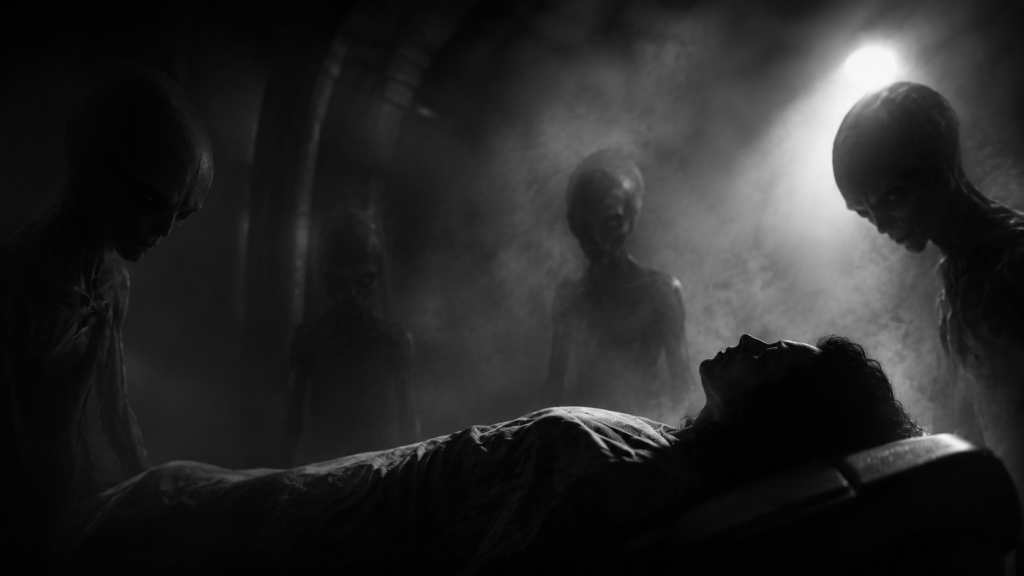
Under hypnosis, the story expanded into a full abduction account. The Hills described being stopped, taken aboard a craft, separated, examined, and later returned. The beings were described as humanoid, but they were not yet identical to the later pop-culture Grey alien. The modern Grey — small body, oversized head, huge black almond-shaped eyes, minimal facial features — would become standardized later. The Hill beings helped move the image in that direction, especially through Barney’s emphasis on the eyes and the disturbing emotional quality of the encounter.
From an evidentiary perspective, however, hypnosis is the weakest and most controversial part of the case. A 1985 JAMA article from the American Medical Association’s Council on Scientific Affairs concluded that memories obtained under hypnosis can involve confabulations and pseudomemories and may be less reliable than ordinary recall.
This does not mean the Hills were lying. It means that hypnosis is not a reliable instrument for establishing historical fact. A person can sincerely experience recovered memories as vivid, emotional, and meaningful, while those memories may still be shaped by suggestion, imagination, dreams, stress, cultural material, or later interpretation.
That distinction is essential for writing about this case responsibly. The Hill story should not be dismissed as a simple hoax, but it also should not be presented as proven evidence of extraterrestrial abduction.
Physical traces: intriguing, but not decisive
The physical traces in the Hill case are part of what made the story memorable. Betty’s torn and stained dress, Barney’s scraped shoe, and the broken binocular strap gave the narrative a material dimension. The fact that UNH preserves items and records connected with the case gives it a stronger archival footprint than many UFO stories.
However, physical traces are not the same as physical proof. A torn dress can be real without proving how it was torn. A scraped shoe can be real without proving an abduction. A broken strap can support the idea that something stressful happened, but it does not identify the cause.
For that reason, Physical traces should be treated as a secondary category. These elements are important to the atmosphere and history of the case, but they do not independently establish the extraordinary claim.
The star map and the search for cosmic origin
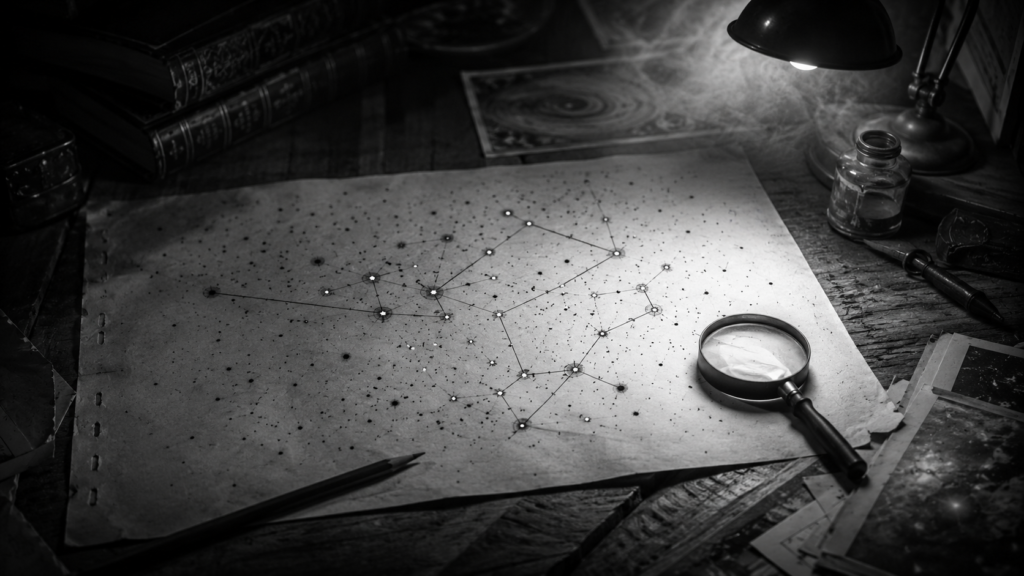
One of the most famous details from Betty Hill’s hypnotic account is the star map. She described seeing a map aboard the craft and later produced a sketch. In UFO literature, this became linked to the work of Marjorie Fish, who attempted to match the pattern to nearby star systems, most famously Zeta Reticuli.
The star-map claim is one of the reasons the Hill case became so durable. It offered something more specific than a vague memory: a possible astronomical clue. The UNH archive’s finding aid includes extensive material related to star charts, Marjorie Fish, Zeta Reticuli, and commentary by figures including Carl Sagan and Robert Sheaffer.
But the star map remains highly disputed. Its interpretation depends on assumptions about which points matter, which lines should be emphasized, what perspective should be used, and which astronomical data are accepted. As a result, it is better understood as a fascinating part of UFO history than as confirmed evidence of extraterrestrial origin.
Government records and Project Blue Book
The Hill case also belongs, in a limited way, under Government documents, because it exists within the broader historical context of Project Blue Book and U.S. Air Force UFO investigations. The National Archives states that Project Blue Book ran from 1947 to 1969, collected 12,618 UFO reports, and left 701 categorized as unidentified. The Air Force’s later summary concluded that no UFO report investigated by the Air Force showed evidence of a national-security threat, advanced technology beyond scientific knowledge, or extraterrestrial vehicles.
That context is important, but it should be handled carefully. Government interest in UFO reports does not automatically mean government confirmation of alien visitation. A report can be investigated because it is unusual, because it involves airspace, or because it was submitted to official channels. Investigation is not endorsement.
Skeptical explanations
The Hill case has several skeptical interpretations. These include misidentification of astronomical or terrestrial lights, stress, fatigue, memory distortion, dream influence, cultural suggestion, and the unreliability of hypnotic regression.
A skeptical interpretation does not require accusing the Hills of dishonesty. Many researchers emphasize that sincere people can misperceive events, especially at night, under stress, while tired, and in emotionally charged circumstances. Skeptical writers also point to the role of cultural scripts: once a society has a recognizable “alien abduction” pattern, later memories and reports may unconsciously organize themselves around that pattern.
Susan Clancy’s work on alien-abduction belief, reviewed by Skeptical Inquirer, argues that abduction experiences can be interpreted through sleep paralysis, hallucinations, cultural scripts, and false memories developed through hypnosis or guided imagery. The review also notes an important point: people who report such experiences should not simply be dismissed as “crazy” or publicity seekers. Many are ordinary people trying to explain powerful experiences.
This is a useful framing for the Hill case. The story can be approached with empathy and skepticism at the same time.

Why the case matters for the Grey alien archetype
The Hill beings were not exactly the later Grey aliens of film posters, book covers, and internet culture. Yet the case helped push alien imagery in that direction.
Earlier extraterrestrials in science fiction and UFO lore varied widely: beautiful space brothers, robotic entities, insect-like creatures, giant monsters, or human-looking visitors. The Hill case introduced a colder, more clinical image: small humanoid beings, a craft interior, controlled movement, examination rooms, telepathic or non-verbal communication, and emotionally overwhelming eyes.
Later abduction narratives would repeat and refine these elements. Over time, the beings became more standardized: short, grey-skinned, large-headed, black-eyed, emotionally unreadable. The medical examination became almost ritualized. The bedroom encounter and sleep paralysis version would later become common. The Hill case did not create every detail, but it helped assemble the grammar of the modern abduction story.
Conclusion: The case that became a pattern
The Betty and Barney Hill case remains powerful because it sits at the crossroads of testimony, fear, memory, history, race, Cold War anxiety, UFO belief, and modern mythology. It is not simply a story about a strange object in the sky. It is a story about what happens when an unexplained experience becomes a narrative, when a narrative becomes a cultural model, and when that model shapes how later generations imagine contact with non-human intelligence.
For believers, the case remains one of the earliest and most compelling alien-abduction accounts. For skeptics, it is a landmark example of how memory, hypnosis, expectation, and culture can produce sincere but unreliable extraordinary claims. For historians of UFO culture, it is indispensable.
The Hills’ alleged abductors were not yet the fully formed Greys of late twentieth-century pop culture. But in the darkness of that New Hampshire road, the outline of the modern Grey began to appear: silent, clinical, watchful, and unforgettable.